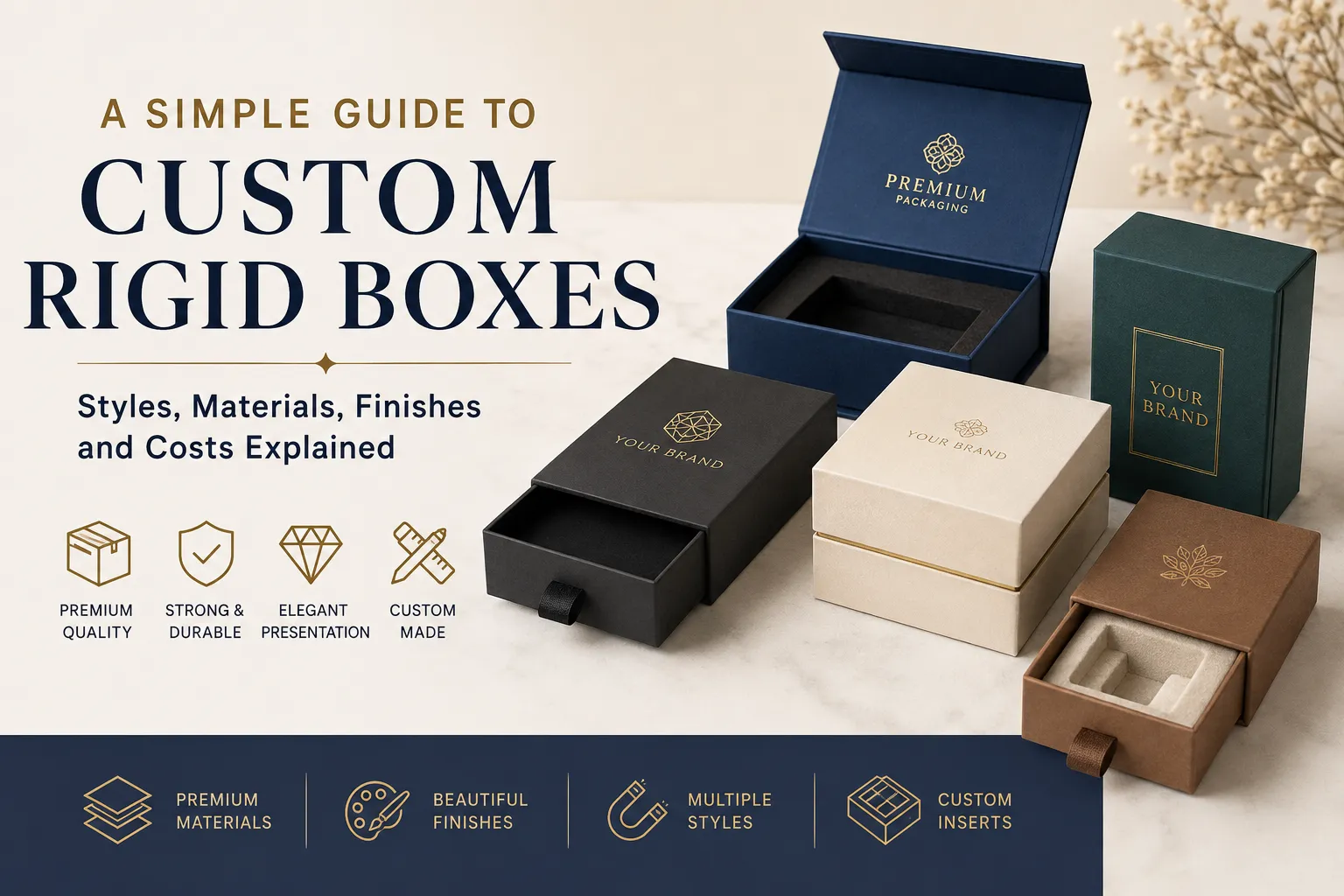
Packaging is often the first physical part of a product that a customer sees and touches. For products such as jewelry, cosmetics, watches, candles, electronics, clothing, and gift sets, a thin folding carton may not give the strength or appearance the product needs. This is where custom rigid boxes can be a better choice.
Rigid boxes are known for their firm shape, neat finish, and solid feel. They can be made in the exact size of a product and printed with a company name, logo, colors, or artwork. Brands can also add inserts, ribbons, magnetic lids, textured paper, foil printing, and other details.
This guide explains what custom rigid boxes are, how they are made, which styles are available, and what you should check before ordering them.
What Are Custom Rigid Boxes?
A rigid box is a firm paper-based box made from thick board. The board is cut into the required shape and then covered with printed paper, kraft paper, textured stock, fabric-style paper, or another wrapping material. These boxes are also commonly called setup boxes because many of them arrive already formed and ready to use.
A normal folding carton is delivered flat and takes shape when it is folded. A traditional rigid box does not usually fold flat. Its walls stay firm, which gives the box more strength and a more substantial feel. Collapsible rigid boxes are an exception because they can be folded for easier storage and shipping.
Custom rigid boxes can be made to match the length, width, and height of a product. This helps keep the item secure and reduces unnecessary empty space inside the package.
Why Do Brands Use Rigid Packaging?
Rigid packaging costs more than many standard folding cartons, so it is usually chosen for products where appearance, protection, and presentation matter. It is often used for high-value products, gifts, limited editions, subscription sets, and product launches.
- Better protection: Thick board helps the package keep its shape during handling, display, and storage.
- A clean presentation: Straight edges and firm walls give the package a tidy and finished appearance.
- Custom sizing: The box can be made around the product instead of forcing the product into a standard size.
- More printing choices: Brands can use simple one-color printing, full-color artwork, foil, embossing, or textured wrapping.
- Useful after purchase: Customers may keep a strong box for storage, gifting, or organizing small items.
Popular Custom Rigid Box Styles
The best box structure depends on the product, budget, opening style, and amount of storage space available. The following styles are widely used.
Two-Piece Rigid Boxes
This box has a separate lid and base. It is simple, strong, and works well for clothing, candles, chocolates, gift sets, and many retail products.
Magnetic Closure Boxes
Small magnets are hidden inside the lid and front panel. The lid opens like a book and closes with a light click. This style is often used for cosmetics, electronics, PR packages, and corporate gifts.
Drawer or Slide Boxes
An inner tray slides out from an outer sleeve. A ribbon or thumb cut can be added to make opening easier. Drawer boxes suit jewelry, perfume, small accessories, and gift products.
Shoulder and Neck Boxes
This structure has a raised inner section between the lid and base. The visible middle layer can use a different color to create a sharp, neat contrast.
Hinged-Lid Boxes
The lid stays attached to the base. This keeps both parts together and makes the box suitable for products that customers may open many times.
Collapsible Rigid Boxes
These boxes fold flat when they are not being used. They need less storage space than fully assembled boxes and can be useful for larger orders.
| Box style | Best for | Main benefit |
|---|---|---|
| Two-piece box | Clothing, candles, gifts and chocolates | Simple structure with many size options |
| Magnetic box | Cosmetics, electronics and presentation sets | Attached lid and secure closing action |
| Drawer box | Jewelry, perfume and small accessories | Interesting slide-out opening |
| Shoulder and neck box | Perfume, watches and high-end gifts | Distinct layered appearance |
| Collapsible box | Retail sets, gifts and larger orders | Uses less storage and shipping space |
Materials Used in Rigid Boxes
Rigid Board
The main structure is commonly made from dense greyboard or chipboard. Board thickness should be selected according to the size and weight of the product. A small jewelry box and a large gift set will not need the same board strength.
Wrapping Paper
The outside board is normally covered with paper. The wrapping material may have a smooth, matte, glossy, kraft, linen-style, soft-touch, or textured finish. The choice should match the product and the way the box will be handled.
Custom Inserts
An insert holds the product in place and improves the inside presentation. The correct insert is especially important when a box contains glass, bottles, jars, electronics, or several small products.
- Paperboard inserts: A simple choice for light products and printed compartments.
- Corrugated inserts: Useful when extra strength or cushioning is needed.
- Foam inserts: Cut to fit fragile or valuable items.
- Molded pulp inserts: Made from paper fiber and suitable for many product shapes.
- Fabric-covered inserts: Often used for jewelry, watches, awards, and gift pieces.
Printing and Finishing Choices
A rigid box does not need many decorative details to look good. A clear layout, correct colors, readable text, and a well-placed logo are often more effective than covering every part of the box.
Printing Options
- Full-color printing: Suitable for photographs, patterns, illustrations, and detailed artwork.
- Pantone color printing: Useful when a specific company color needs to remain consistent.
- Inside printing: Adds messages, instructions, patterns, or product information beneath the lid.
Finishing Options
- Foil stamping: Adds a metallic or colored foil to selected words, borders, or logos.
- Embossing: Raises a logo or design above the paper surface.
- Debossing: Presses a design into the surface.
- Spot UV: Adds shine to selected areas while the rest of the surface stays matte.
- Matte or gloss lamination: Changes the surface feel and adds protection to the printed paper.
- Ribbons and handles: Help with opening or carrying the box.
Before approving production, check small text, logo size, color contrast, foil position, and the distance between artwork and folded edges. These details may look different on a physical box than they do on a screen.
What Affects the Cost of Custom Rigid Boxes?
There is no single price for custom rigid packaging. The cost changes according to the box design and order details.
- The length, width, and height of the box
- The thickness and amount of board used
- The type of wrapping paper
- The number of printed colors
- The box structure and number of separate parts
- The type of insert
- Foil, embossing, spot UV, ribbons, handles, or magnets
- The number of boxes ordered
- Sampling, assembly, packing, and delivery requirements
Complex structures normally need more materials and production steps. Larger orders may reduce the cost per box, but businesses should also consider storage space and how quickly the packaging will be used.
How to Make Rigid Packaging More Responsible
Paper-based packaging still uses materials, printing, energy, and transport. A responsible design should use only what is needed to protect and present the product.
- Choose a box size that fits the product closely.
- Ask whether recycled-content board is available.
- Ask about paper from responsibly managed sources.
- Avoid extra layers that do not serve a clear purpose.
- Use fewer mixed materials when possible.
- Make removable inserts easy to separate from the box.
- Design the box so customers can reuse it.
- Check local recycling rules before making recycling claims.
A simple box made with suitable materials can be a better choice than an oversized package filled with unnecessary trays, plastic parts, and decorations.
What to Check Before Ordering Custom Rigid Boxes
Prepare These Details for Your Packaging Supplier
- Exact product dimensions and weight
- Required inside and outside box dimensions
- Preferred box style
- Number of products placed in each box
- Insert material and compartment layout
- Logo, text, colors, and artwork files
- Required printing and finishing options
- Order quantity
- Delivery location and required date
- Whether a physical sample is needed
Measure the Actual Product
Measure the final product, including caps, cables, booklets, accessories, protective bags, and any other items placed inside the box. Do not rely only on measurements from an early product drawing.
Request a Sample
A physical sample lets you check the size, opening action, color, wrapping, insert fit, logo position, and overall strength. It can also reveal problems that are difficult to notice in a digital drawing.
Test the Complete Pack
Put the real product inside the sample. Open and close the box several times. Check whether the product moves, whether the insert bends, and whether the lid stays aligned. Shipping tests may also be needed when the finished box will travel through courier or postal systems.
Approve Written Specifications
Make sure the final quotation or order sheet lists the approved size, board, paper, printing, finish, insert, quantity, packing method, and delivery terms. Written details reduce the chance of confusion after production starts.
Which Products Work Well with Rigid Boxes?
Custom rigid boxes can be used in many industries, but they are most useful when a product needs firm protection or a carefully arranged presentation.
- Jewelry, watches, and fashion accessories
- Perfume, skincare, makeup, and beauty sets
- Candles, soaps, and personal care products
- Phones, headphones, chargers, and small electronics
- Clothing, scarves, ties, and fashion gift sets
- Chocolate, confectionery, and dry food gift boxes
- Books, stationery, invitations, and presentation kits
- Corporate gifts, awards, samples, and promotional sets
The packaging should still match the selling price and use of the product. A highly decorated rigid box may not be necessary for a simple low-cost item. The best design is one that protects the product, supports the required presentation, and stays within budget.
Frequently Asked Questions
What is the difference between a rigid box and a folding carton?
A rigid box uses thick board and normally keeps its finished shape. A folding carton is made from thinner paperboard and is usually delivered flat before being folded into shape.
Can rigid boxes be printed with a logo?
Yes. Logos can be printed directly on the wrapping paper or added with foil stamping, embossing, debossing, spot UV, or a printed label.
Which rigid box style is best for gifts?
Two-piece, magnetic closure, drawer, and shoulder-neck boxes can all work for gifts. The right choice depends on the product size, opening style, budget, and required presentation.
Do custom rigid boxes need inserts?
Not every product needs an insert. An insert is useful when the product must stay in a fixed position, contains several parts, or needs extra protection inside the box.
Can rigid boxes be made in custom sizes?
Yes. They can be produced according to the required length, width, and height. Accurate product measurements are important because the insert and lid must also fit correctly.
What information is needed for a rigid box quotation?
A supplier normally needs the box dimensions, style, quantity, printing, finish, insert type, delivery location, and required delivery date. Product photographs or samples can also help.
Final Thoughts
Custom rigid boxes are a suitable option for products that need a firm structure and a neat presentation. The box style, size, insert, paper, printing, and finish should all be chosen for a clear reason.
Start with accurate product measurements and a simple design. Then request a sample, test the product inside it, and approve every detail before placing a full order. This careful process can prevent size problems, damaged products, wasted material, and unexpected costs.